
Neutrinos
Neutrinos, the most abundant particles in the universe, are nevertheless the least understood; neutrino physics studies their properties using various sources of neutrinos, such as accelerators and astrophysical sources (DUNE) or nuclear reactors (RICOCHET).
Neutrinos, which come in three flavors—electron, muon, and tau—are among the elementary particles of the Standard Model of particle physics. Since neutrinos generally interact weakly with matter, their discovery is relatively recent—the last neutrino, the tau neutrino, was not discovered until 2000 by the DONUT experiment—and not all of their properties are yet precisely known. Today, experiments aim to determine :
- The Nature of the Neutrino: Is the Neutrino Its Own Antiparticle?
- The Absolute Mass and Mass Hierarchy of Neutrinos: Only the mass differences between two flavors are measured.
- The parameters of charge-parity (CP) violation in the lepton sector, which may partially explain the matter-antimatter asymmetry observed in the universe.
- The mixing matrix parameters that govern neutrino flavor oscillations along their path.
- The existence of physics beyond the Standard Model, such as the discovery of new interactions or sterile neutrinos.
Our group is developing a research program that addresses some of these questions through two experiments: DUNE and RICOCHET.
DUNE - Deep Underground Neutrino Experiment
The DUNE (Deep Underground Neutrino Experiment) is an international particle physics project based in the United States, designed to study the properties of neutrinos. DUNE’s main detector will be located in the Sanford Underground Laboratory, 1.5 km underground in South Dakota, while the neutrino source will be produced at Fermilab, near Chicago, more than 1,300 km away. This configuration will make it possible to study long-distance neutrino oscillations, a phenomenon in which these particles change type as they travel.
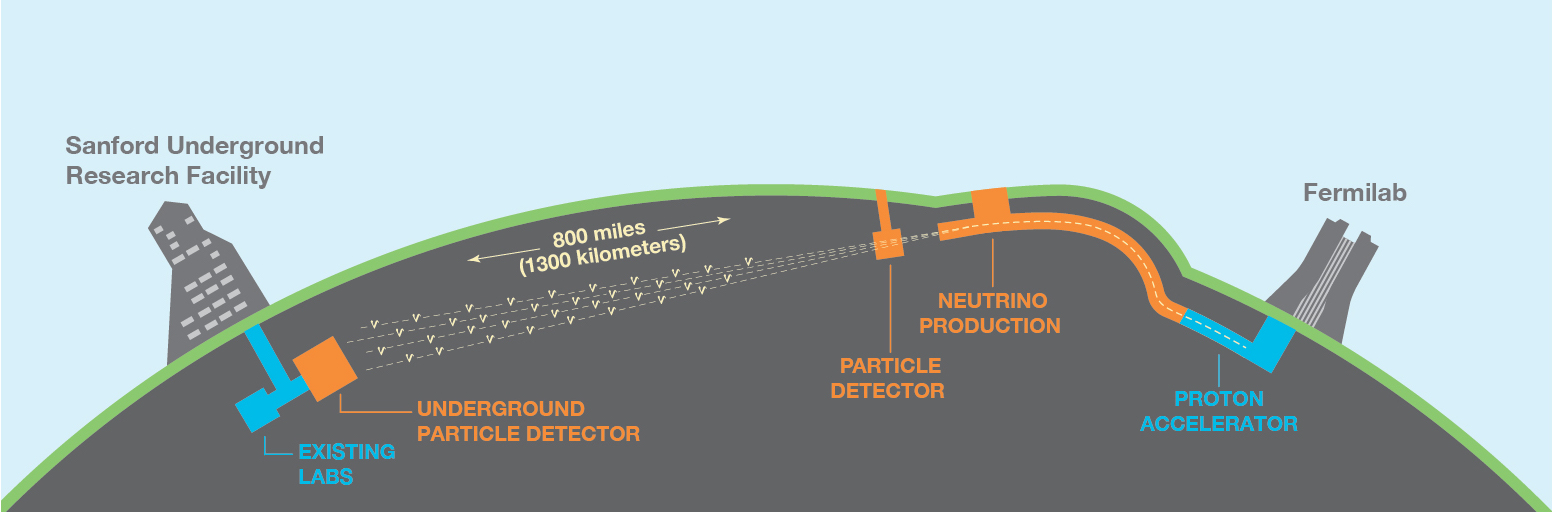
There are many challenges in neutrino physics. In particular, the DUNE experiment should help us understand the neutrino mass hierarchy (which types of neutrinos are heavier than others), whether neutrinos and antineutrinos behave differently (which could explain why our universe consists mainly of matter rather than antimatter), as well as the possibility that neutrinos could be their own antiparticles (which would imply a new fundamental symmetry). Answering these questions would lead to a better understanding of the fundamental laws of physics, as well as the evolution of the universe since the Big Bang.

Internal view of Module 0 at CERN
The distant detector will consist of two (and later four in a second phase) modules, each containing 10,000 metric tons of liquid argon: one horizontal drift module and one vertical drift module, in which France is heavily involved. A prototype of the vertical drift detector, Module 0, is currently undergoing characterization at CERN. The LPSC participated in the integration of the anode planes (CRPs) as well as in the characterization of their continuity. We have also developed the CRT (Cosmic Ray Tagger), a cosmic muon veto detector, as well as several level meters (LMs) with millimeter-level precision, which are used to reposition the anode planes in the event of cryostat deformation caused by extremely low temperatures.
By 2027, the LPSC will manufacture and characterize the upper CRPs for the vertical drift module. To this end, we have developed the CRPFactory in Grenoble—located in the Ariane Hall and with the support of the laboratory’s departments (SDI, electronics, and IT)—which will assemble, test, package, and ship the 80 upper CRPs to their final destination at SURF 71 between 2025 and 2026.
RICOCHET utilizes the neutrinos produced in large quantities by the academic reactor at the Institut Laue Langevin (ILL) at a rate of 10¹² neutrinos per cm² per second. These very low-energy neutrinos (2 to 8 MeV) interact more strongly with matter because they are sensitive to the weak nuclear charge, which is proportional to the square of the number of nucleons: this is known as coherent neutrino-nucleus scattering (CENNS: Coherent Elastic Neutrino-Nucleus Scattering). This behavior, predicted in 1970 by D. Z. Freedman within the framework of the Standard Model, was observed for the first time in 2017 by the COHERENT experiment. RICOCHET aims to make a precise measurement of the interaction cross section for this process, which will help constrain key parameters of the Standard Model, such as the Weinberg angle. Conversely, the detection of deviations would indicate the existence of new physics.
The sensitive part of the detector consists of 18 bolometers—small cylinders 3 cm in diameter and 1 cm in length made of germanium crystal—to which 9 cubic, superconducting zinc crystals will be added in a second phase. The total assembly, weighing approximately 1 kg and occupying a cubic volume of about 10 cm on each side, is housed in a cryostat that maintains an operating temperature of 4 mK: at this temperature, it is possible to detect the low-energy nuclear recoil resulting from the neutrino-nucleus interaction. The goal is to achieve a detection threshold of 50 eV with a resolution of 10 eV, enabling the detection of about ten events per day. The second challenge for RICOCHET is to overcome cosmic background noise—including neutrons and gamma rays—which is expected to be very high due to the experiment’s surface location and proximity to the reactor. The strategy for reducing background noise is based on three approaches: passive shielding made of lead and polyethylene to counter gamma rays and neutrons; layers of scintillators to provide active veto detection against cosmic background; and, finally, signal-reading technology capable of distinguishing nuclear recoils from electronic recoils caused by gamma rays.
At the same time, the RICOCHET group is working on advancing low-temperature detection techniques for TESSERACT: a dark matter search experiment scheduled to be installed at the Modane underground laboratory.
Team members
The Neutrinos group consists of
- Steven Clavez, Chargé de Recherche, CNRS
- Corinne Goy, Directrice de Recherche, CNRS
- Jacob Lamblin, Maitre de Conférences, Université Grenoble-Alpes, responsable du projet RICOCHET
- Valentina Novati, Chargée de Recherche, CNRS
- Jean-Sébastien Réal, Directeur de Recherche, CNRS, responsable du projet DUNE, responsable de groupe
- Jean-Stéphane Ricol, Chargé de Recherche, CNRS
- Arnaud Robert, Maitre de Conférences, Université Grenoble-Alpes
- Silvia Scorza, Directrice de Recherche, CNRS
- Anne Stutz, Chargée de recherche, CNRS
THESES IN PROGRESS
- Guillaume Chemin, [2021-2024] RICOCHET
- Joël Dai, [2021-2024] DUNE
- Joshua Pinchault, [2022-2025] DUNE
- Renaud Serra, [2023-2026] RICOCHET
- Juliette Blé, [2024-2027] de RICOCHET à TESSERACT