
ALICE
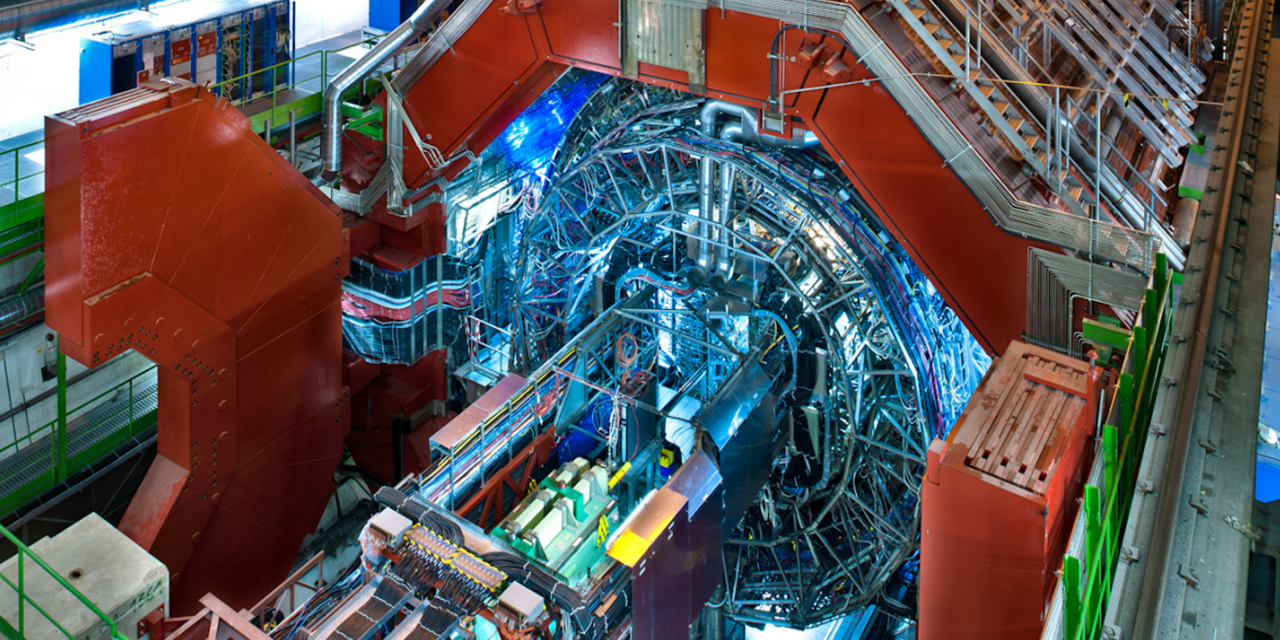
ALICE (A Large Ion Collider Experiment) is one of the eight detection experiments at CERN's Large Hadron Collider
The ALICE team grew out of a hadronic physics group that had been working since the 1990s on the SATURNE accelerator at the CEA in Paris (the POLDER polarimeter) and later on the CEBAF accelerator at Jefferson Laboratory in the U.S. (electromagnetic structure of the deuteron with the t20 experiment, nucleon structure with the G0 experiment, study of light nuclei in Hall A, and study of GPDs in Hall B). Since 2005, our group has been involved in the ALICE experiment at the LHC at CERN.
The scientific motivations behind hadronic physics stem from the study of the strong interaction between the elementary constituents of matter—quarks and gluons. At room temperature, these are confined within hadrons, such as protons and neutrons, which form atomic nuclei. This is why studying the properties of hadrons using electromagnetic probes allows for a better understanding of the interaction between their constituent particles. Furthermore, the use of very high-energy beams at the LHC makes it possible to produce a vast system of deconfined quarks and gluons, known as quark-gluon plasma (QGP). Studying the properties of the QGP provides valuable insights into the strong interaction between these constituents and into the underlying theory, quantum chromodynamics.
These scientific activities are carried out as part of broad international collaborations and are the result of side exchanges with several foreign universities, such as the Universities of Tsukuba (Japan), Wuhan (China), and Lebanon.
ALICE at LHC
Most of our team members work on the ALICE experiment at the LHC. The goal is to create a specific state of matter through very high-energy heavy-ion collisions (such as lead). This state, known as quark-gluon plasma, can be studied using the ALICE detector at CERN.
Our group has been actively involved in this international collaboration, contributing to both the hardware and the experimental analyses. Among other things, we have assembled and calibrated an EMCAL electromagnetic calorimeter. We are also currently participating in the expansion of this calorimeter’s azimuthal coverage.
Research team : permanent staff
- Gustavo Conesa-Balbastre, Chargé de recherche au CNRS.
- Julien Faivre, Maitre de conférence (HDR) à l'UGA.
- Christophe Furget, Professeur d'université à l'UGA, Responsable du groupe ALICE
- Rachid Guernane, Chargé de recherche au CNRS.
Research team : PhD student and Postdocs
- Jaime Norman, contrat post-doctoral 2007-.
- Hadi Hassan, thèse de doctorat cotutelle UGA-Université libanaise 2016-, Modeling and measuring the b-jet nuclear modification factor in p-Pb at 5,02 TeV with ALICE experiment at the LHC.
- Ritsuya Hosokawa, thèse de doctorat cotutelle UGA-Tsukuba 2016-, Production inclusive et propriétés des jets en collision p-p et Pb-Pb à 5,02 TeV avec l’expérience ALICE auprès du LHC.