

Overview

A laboratory for understanding the infinitely small and the infinitely large
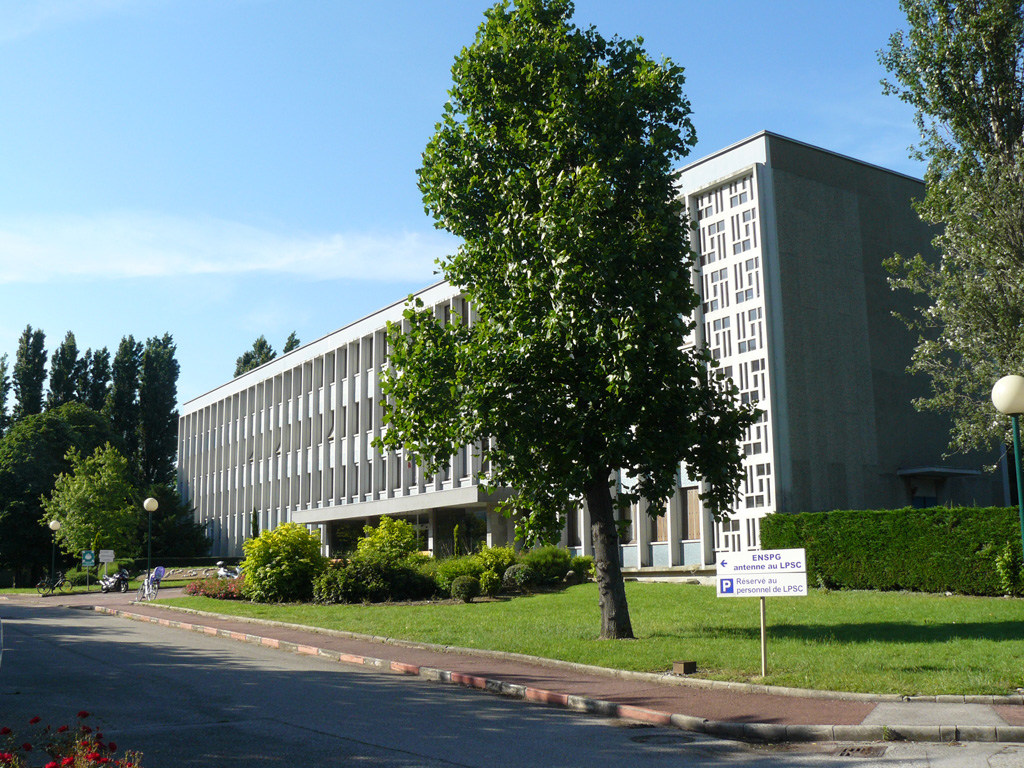
The LPSC laboratory is a Joint Research Unit (UMR5821). It is affiliated with the CNRS Institute of Nuclear and Particle Physics (IN2P3), the University of Grenoble Alpes (UGA), and Grenoble INP. It is located at two sites: the main site is within the Grenoble Science Park, while the LSM national underground facility is located in Modane.
The laboratory’s staff, at the heart of our research activities, consists of approximately 220 people. The LPSC has nearly 40 CNRS researchers, 19 faculty members from UGA, and 9 from Grenoble INP. The ITA staff comprises more than 90 people, including 85 CNRS employees. Finally, the laboratory hosts approximately 35 doctoral students and 15 postdoctoral researchers and fixed-term contract employees, in addition to some 50 interns of all levels each year.
While the laboratory’s recurring financial resources come primarily from our sponsoring organizations—the CNRS and the university—in recent years an increasing portion of our funding has come from three LABEx programs in which the LPSC is a partner (ENIGMASS, FOCUS, and PRIMES) and from one EQUIPEx program (BEDOFIH), as part of the “Investments for the Future” initiative. Finally, a significant portion of our funding comes from successful applications to national and international calls for proposals (ANR and the European Union).
Translated with DeepL.com (free version)
Laboratory Research
The laboratory’s mission focuses on basic research in the fields central to IN2P3: particle physics, nuclear physics, astroparticle physics, and cosmology, as well as their applications and developments in nuclear energy and health, accelerators, ion sources, and plasmas.
The laboratory is organized around four distinct scientific areas to which research teams contribute: “From Quarks to Nuclei,” “Astroparticle Physics, Cosmology, and Neutrinos,” “Energy and Health,” and “Accelerators, Ion Sources, and Plasmas.” This structure links research teams with technical services, which bring together the expertise essential for implementing projects at all levels. Research activities are carried out within a “project policy” that incorporates a quality assurance approach at every stage.
A Scientific Council evaluates the relevance of research projects, and a Technical Project Review Committee ensures that the required resources align with the workload plans of the technical services. These two advisory bodies assist in defining and implementing the scientific program.
The four research areas have seen a series of notable developments over the past two years—these are described in detail in the chapters dedicated to them.
Translated with DeepL.com (free version)