My main research activity is devoted to Quantum Chromodynamics. QCD is the theory of strong interaction, whose ambition is to explain nuclei cohesion as well as neutron and proton structure, i.e. most of the visible matter in the Universe. With General Relativity, it is one of the most elegant theories of Science History; it has only very few parameters and allows giving a physical interpretation to a very broad range of phenomena using a well defined and very compact formalism. Since 2023 I have also been working on quantum computing and quantum simulation.
Lattice QCD

The only systematic and rigorous method to solve QCD ab initio is Lattice QCD (LQCD). Proposed by Kenneth Wilson in 1974, its principle is inspired by Statistical Physics and uses path integral formulation of QCD in Euclidean space. LQCD aims at providing solutions of this fundamental theory of matter, without uncontrolled hypothesis, and with accuracies which rival that of experimental data. The calculations rely on stochastic methods and are very demanding in computing time.
I am a member of the ETM Collaboration. My research topics in Lattice QCD include
- hadron spectrum
- nucleon and meson structure
- non-perturbative renormalisation
- quark masses and strong coupling constant determination
Selected publications in lattice QCD
-
2024
The distribution amplitude of the ηc-meson at leading twist from lattice QCD
-
2021
Quark masses using twisted mass fermion gauge ensembles
-
2018
Simulating twisted mass fermions at physical light, strange and charm quark masses
-
2018
The pion vector form factor from lattice QCD at the physical point
Quantum physics & quantum computing
Quantum computers are a natural tool for problems where classical methods run into the exponential growth of the Hilbert space, such as real-time dynamics, many-body systems and gauge theories. I work on quantum algorithms and quantum simulation for such problems, with a focus on dynamics that are hard to handle classically. This extends my work on QCD towards the quantum-simulation era.
Quantum algorithms for non-unitary dynamics
Efficient quantum solution of the time-dependent Schrödinger equation with a complex absorbing potential, where the evolution is not unitary.
Neutrino oscillations & many-body dynamics
Phase-space methods for collective neutrino flavor oscillations: multi-beam extension and three-flavor case, with a view to quantum simulation.
Analog quantum simulation
Choosing and optimizing how a problem is encoded on an analog quantum simulator, using the reachability of its dynamical algebra.
Selected publications in quantum physics
-
2026
Optimizing quantum encodings for analog simulation through dynamical algebra reachability
-
2026
Three-flavor neutrino oscillations using the phase space approach
-
2024
Phase-space methods for neutrino oscillations: extension to multibeams
-
2024
Efficient solution of the non-unitary time-dependent Schrödinger equation on a quantum computer with complex absorbing potential
Perturbative QCD
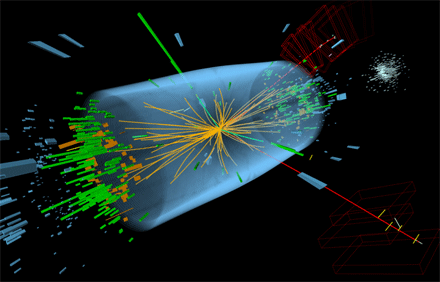
Perturbative QCD (pQCD) relies on one of the most striking properties of QCD: asymptotic freedom. It is the critical link between theory and collider experiments, and has proved an invaluable tool in the study of the strong interactions. pQCD calculations are especially important for the Large Hadron Collider physics. LHC is indeed essentially a "QCD factory", working in an energy range never explored before. The discovery potential of the LHC depends crucially on the quality of QCD signals and background predictions.
My research interests in perturbative QCD focus on
- Evolution codes
- Markov Chain Monte Carlo methods
- PDF uncertainty estimates
- strong coupling constant
For more information, please do not hesitate to contact me directly.
Brief scientific CV
- 1998 – 2001 PhD at the Institut des Sciences Nucléaires (now L.P.S.C.): Relativistic description of simple composite systems using Light-Front Dynamics. (thesis).
- 2001 – 2004 Research assistant at CERN on the ATLAS experiment, Geneva University Physics Department.
- 2004 – 2009 CNRS researcher at L.P.S.C., sharing my time between cosmic-ray physics (AMS and CREAM experiments) and Lattice QCD.
- 2009 – 2022 Activity entirely devoted to QCD: Lattice QCD (ETM Collaboration) and perturbative QCD.
- 2023 – today Quantum computing and quantum simulation, alongside QCD.