
Observational cosmology
The team has a long-standing commitment to observational and instrumental cosmology (the Archeops balloon in 1998 and the Planck satellite beginning in the 2000s). It is now looking ahead to future ground- and space-based CMB (cosmic microwave background) projects (LiteBIRD and SO). Its expertise in KID (Kinetic Inductance Detector) technology enables it to develop new instruments, as it has done for the NIKA, NIKA2, and CONCERTO projects.
For more than ten years, the team has also been involved in two major fourth-generation galaxy survey projects (Euclid and LSST). After contributing to the construction and science preparation phases, we are now preparing for and participating in the data validation and scientific analysis of these surveys.
The experiments in which we participate aim to characterize the composition of our Universe and trace its evolution. To this end, we have always been deeply involved in the development of various ground-based and space-based instruments, which has allowed us to acquire extensive expertise and know-how in the development and operation of various types of detectors. We are also involved in data analysis and interpretation, with expertise in statistical methods and machine learning. These various aspects contribute to the team’s multidisciplinary nature, with expertise in instrumentation, data analysis, and phenomenology.
- Instrumentation: The team has developed expertise in KID (“Kinetic Inductance Detectors”) technology, particularly for instruments dedicated to cosmology. These developments are carried out as part of a Grenoble-based collaboration in this field, which led to the creation of the GIS KIDs. We are also leading the COSMOCal project, a space-based calibrator for polarization measurements. For many projects, we benefit from the laboratory’s technical support, for example in the design and electronics of NIKA2 detectors and cameras, or in the construction of the LSST filter loader and CCOB (“Camera Calibration Optical Bench”).
- Data analysis: The development of data analysis “pipelines,” calibration, “commissioning,” and the characterization of the performance of new experiments constitute the second major component of our activities. These activities provide significant visibility and enable team members to play major roles in international collaborations (CONCERTO, Euclid, Rubin-LSST, NIKA2). It is indeed at this stage that the control of systematic effects is determined, which is critical to the success of the scientific operation.
- Data Interpretation: The analysis and interpretation of the collected data constitute the final major component of our activities. Over the years, the team has made significant contributions to experiments measuring the cosmic microwave background (CMB) in terms of temperature and polarization. In particular, it has worked on reconstructing the gravitational lensing effect on the CMB and measuring the Sunyaev-Zeldovich (SZ) effect.
The team is now fully engaged in the preparation and operation of the two major surveys, Euclid and LSST. At the same time, the team continues to be a driving force in contributing to the next generation of ground- and space-based CMB instruments (LiteBIRD and SO).
Team Projects and Activities (in alphabetical order)
- Activités instrumentales (salle millimétrique)
- CONCERTO (et prototype KISS)
- COSMOCal
- Euclid
- LiteBIRD
- LSST (énergie et matière noire, transitoires, « computing »)
- NIKA2
- RadioForegroundsPlus (ERC)
- Rayonnement cosmique et détection indirecte de matière noire
- SO
Instrumental Activities (Millimeter Room)
The LPSC, Institut Néel, IPAG, and IRAM laboratories are leading the development of the new generation of cryogenic KID (“Kinetic Inductance Detectors”) as part of the KIDs Scientific Interest Group (GIS). The GIS aims to ensure and enhance the visibility of the collaboration’s activities. The scope of the KIDs GIS includes the fabrication and photometric validation of KIDs, cryogenics, the readout and data acquisition system, auxiliary instrumentation, and scientific calibration. Our team, along with the electronics, mechanics, and SDI departments, plays a key role in the development of the readout system and acquisition software, the design and fabrication of the imaging optics, and the characterization measurements of the detectors. In 2021, we expanded the GIS KIDs’ activities by equipping a new millimeter-wave laboratory at the LPSC. This laboratory was set up in the lab’s project hall and operates in parallel with the one at the Institut Néel. The millimeter-wave room is designed around the KISS instrument, which was brought back to Grenoble and modified to meet the requirements of laboratory measurements. In addition to the KISS instrument, the facility includes a range of state-of-the-art equipment, such as a test bench for readout electronics, a computer network for data acquisition, a sky simulator, and a pointing table to simulate astrophysical observations, as well as a polarization modulation and measurement system.
(retourner à la liste des projets)
CONCERTO (et prototype KISS)
The LPSC, as part of GIS-KIDS, has been a driving force in the development of ground-based millimeter-wave spectro-imagers based on KIDS using Martin-Pupplet (MPI)-type interferometers. KISS, which was installed on the QUIJOTE telescope at the Teide Observatory in Tenerife from late 2018 through 2020, served as a prototype experiment. The instrument was designed and built as part of the GIS-KIDS project under the leadership of the LPSC, with significant contributions from the LPSC’s technical departments (mechanical engineering, instrumentation, and electronics). The CONCERTO instrument (“CarbON CII line in post-reionization and ReionisaTiOn”), which was operated at the APEX telescope at 5,000 m in Chile, was built with ERC Senior Grant funding in collaboration with the LAM. CONCERTO uses two arrays, each containing 2,172 detectors, corresponding to a focal plane 18.6 arcminutes in diameter, in the spectral range from 130 to 310 GHz, and with a maximum spectral resolution of 1.8 GHz. The LPSC was responsible for the optical design as well as the design and fabrication of the electronics and the data acquisition system. CONCERTO operated successfully from April 2021 to May 2023.COSMO-ML members regularly participated in observation and instrument maintenance campaigns. These efforts ensured the completion of the extensive [CII] “line intensity mapping” program, totaling 1,300 hours in the COSMOS field. In addition, the LPSC spearheaded and managed SZ spectrum observations for approximately 300 hours in five galaxy clusters. Currently, we are heavily involved in developing the spectroscopic data pipeline and analyzing SZ data from galaxy clusters to measure their mass, temperature, and velocity.
(retourner à la liste des projets)
COSMOCal

Detecting the signature of primordial gravitational waves in the polarization of the cosmic microwave background (CMB) would open up unprecedented insights into the fundamental physics governing the universe. Increasingly sensitive observatories are being developed to achieve this goal. Increased sensitivity must go hand in hand with precise data calibration. The goal of the COSMOCal project is to place a polarized microwave source in space that will be used to calibrate measurements from large-aperture ground-based telescopes, thereby establishing a set of reference sources for ground- and space-based observations with the required precision.
The COSMOCal collaboration brings together researchers and engineers with experience in all aspects of the project: the design and development of space instruments, ground-based microwave observations, data analysis, observational cosmology, and galactic astrophysics. Our partnership with EUTELSAT promotes the use of commercial space platforms for scientific research.
(retourner à la liste des projets)
Euclid
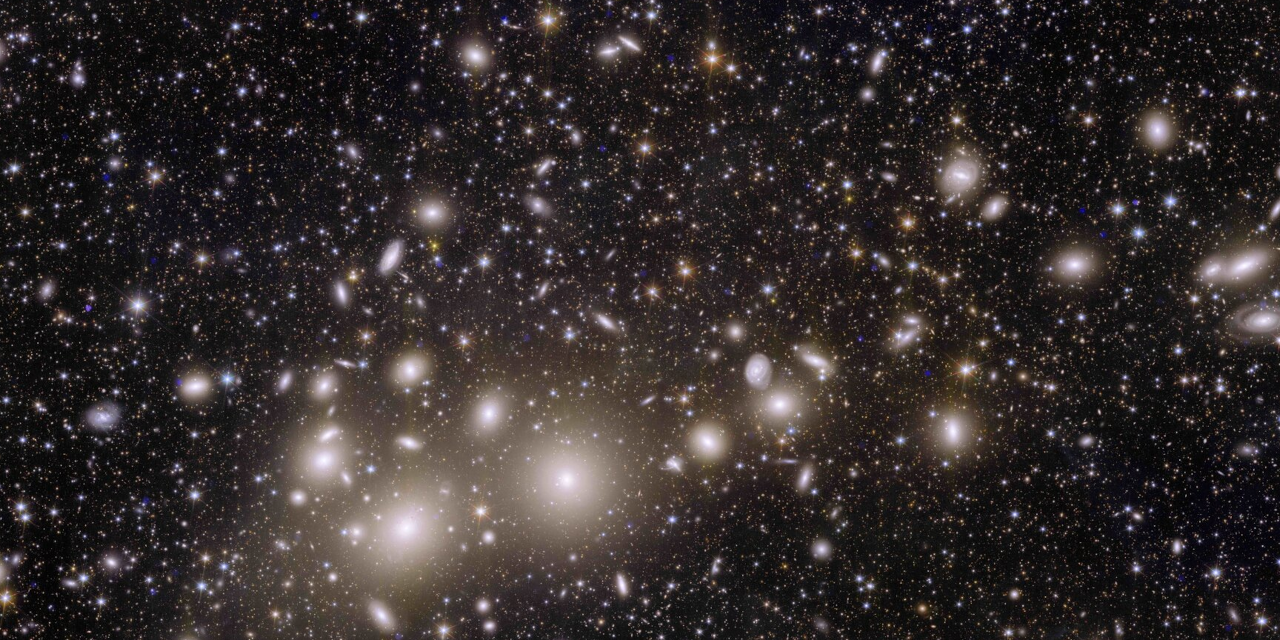
This is an ESA satellite mission, launched to the L2 Lagrange point in July 2023, aimed at studying cosmology in the visible and infrared spectrum through weak gravitational lensing, galaxy clustering, and galaxy clusters. With two state-of-the-art instruments—the VIS visible imager and the NISP infrared spectrometer—and extremely broad sky coverage, Euclid represents a major cosmology experiment for the coming decades. The team is heavily involved in characterizing the NISP, overseeing electromagnetic compatibility testing of the detectors as well as calibration sources. We are currently heavily involved in analyzing Euclid data within the “Science Ground Segment.” In this context, we are responsible for analyzing internal data, as well as constructing masks for observational properties, instrument characteristics, and sky brightness. Spatial variations in these factors can lead to systematic effects in galaxy detection. We are working on developing algorithms to correct the 3x2-point correlation function and the galaxy cluster detection function for these effects. We also participate in the “Science Working Group” on lensing and galaxy clusters to study systematic effects in the estimation of cosmological parameters.
(retourner à la liste des projets)
LiteBIRD
The LiteBIRD satellite experiment is a next-generation project by JAXA, NASA, and ESA, scheduled for launch in 2033. It aims to measure the polarization anisotropies of the cosmic microwave background (CMB), including the B-modes caused by primordial gravitational waves. This experiment will feature an unprecedented frequency range (14 frequency bands between 34 and 448 GHz) with three instruments (LFI, MFI, and HFI) and unmatched sensitivity. As a result, it will provide the most precise measurement of inflation energy to date, opening the door to the physics of the early Universe. The team has taken charge of the ground-based characterization of polarization measurements using the mid- and high-frequency instruments. We are also involved in preparing the data analysis, particularly with regard to in-flight calibration and the correction of systematic effects. We are also participating in physics studies, including the measurement of the SZ effect and foreground polarization emissions. Understanding these emissions will be fundamental to achieving the cosmological objectives.
(retourner à la liste des projets)
LSST (dark energy and dark matter, transients,« computing »)
Rubin Observatory, LSST Survey, and Dark Energy
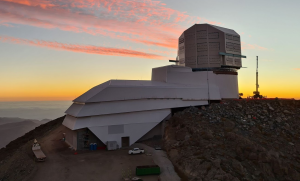
Photo of the construction (taken in April 2022) of the Vera C. Rubin Observatory at Cerro Pachón, Chile, at an elevation of 2,682 m (credit: Rubin Obs/NSF/AURA).
Observational cosmology—and in particular observations of distant supernovae—has shown that the universe is undergoing accelerated expansion. This acceleration can be explained by the addition of an energy component with negative pressure, similar to a cosmological constant, but of as yet unknown origin. To better understand the nature of this component (called dark energy) and the cosmological model as a whole, the “Legacy Survey of Space and Time” (LSST), conducted at the Vera C. Rubin Observatory (Chile, see figure), will trace the history of the Universe’s expansion using a number of cosmological probes. The telescope will observe nearly half the sky, two to three times a week, for ten years, and will detect hundreds of thousands of supernovae and billions of galaxies. With over three billion pixels, the camera positioned at the telescope’s focal point is the largest CCD camera ever built. IN2P3 was responsible for the construction and commissioning of the filter changer system, and the LPSC’s technical services developed the filter loader as well as the CCOB (“Camera Calibration Optical Bench”). The “Dark Energy Science Collaboration” (DESC), in which part of the team is heavily involved, coordinates the cosmological analysis of LSST data.
Cosmology Using LSST Galaxy Clusters
Galaxy clusters represent the final stage in the formation of structures in the Universe. Their distribution as a function of mass and redshift is sensitive to the content of dark matter and dark energy, as well as to their properties. Using cluster counts as a cosmological probe therefore requires knowledge of their masses. In the visible spectrum covered by Rubin, the weak gravitational lensing effect is the method of choice for estimating mass. This effect consists of a distortion of spacetime caused by the cluster’s gravitational potential (and thus its mass). It results in a distortion of the image of background galaxies (shear) and an increase in their brightness (“magnification”).
We are working to design and develop analysis pipelines that will allow us to extract the maximum amount of information from the galaxy cluster probe through the joint study of the weak gravitational lensing effect and their abundance. As in any analysis aimed at constraining cosmological parameters, controlling the numerous systematic effects (related to projection effects within clusters, the calibration of shear measurements, redshift reconstruction, modeling choices, etc.) is fundamental. This highly collaborative effort has led, in particular, to the development of public software packages (e.g., CLMM), validated, among other things, on simulated data from the DESC collaboration.
Gravitational Shear: From Images to Statistical Analysis
Another cosmological probe under study is gravitational shear caused by galaxies, which has an underlying physics similar to that of cluster-induced shear (see above).
A major challenge for this probe—one that is also common to the study of clusters—is “blending” of galaxies, that is, the overlap of galaxies along the line of sight, due to the unparalleled depth of the LSST survey. If left uncorrected, this effect could impact the entire analysis chain, all the way through to the reconstruction of cosmological parameters. We are therefore working to quantify the impact of this blending on the estimation of cluster masses via gravitational lensing and on cosmology.
At the other end of the analysis chain, we also address methods for extracting cosmological information from lensing data. We are working on generating cosmological simulations within the “Non-Gaussian Statistics” working package at DESC. These simulations will be used in conjunction with innovative statistical tools (leveraging deep learning) for simulation-based analyses of LSST data. Projections indicate that these methods—provided the simulations achieve sufficient accuracy—could be four times more informative than standard analysis based on two-point correlation functions. We have already implemented some of these techniques in the analysis of data from the “Dark Energy Survey,” the precursor to Rubin-LSST.
Star Streams and Constraints on Dark Matter
While the Rubin Telescope is generally viewed as a tool for constraining the nature of dark energy, it has been shown that large galaxy surveys also provide excellent and diverse ways to constrain the nature of dark matter. In particular, current dark matter models predict a hierarchical formation of halos down to subgalactic masses. Studying the gravitational interaction between dark matter halos and stellar streams is one of the few ways to detect dark (baryon-free) halos at these scales.
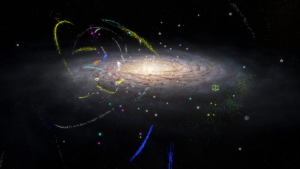
Artist’s rendering of the Milky Way and its stellar streams (colored dots), globular clusters (marked with a “star” symbol), and spheroidal dwarf galaxies (small cubes). © S. Payne-Wardenaar / K. Malhan, MPIA.
Stellar streams are satellite galaxies of the Milky Way that have been stretched by tidal forces into trails of stars orbiting our Galaxy. As they pass close by, the dark halos of dark matter deflect and gravitationally strip away stars. Analysis of density fluctuations in stellar streams provides information about the halos that have disturbed them. The detection and characterization of these stellar streams therefore offer a way to test the predictions of the leading dark matter models—such as WIMP or axion models—and to compare them with alternative models, such as those involving hot, fuzzy, or self-interacting dark matter.
Over the course of ten years, Rubin/LSST will observe 20 billion stars, enabling us to discover new stellar streams below current detection thresholds and to expand the statistical sample of stars in already known streams. We are preparing the many tools needed for these studies before proceeding with the analysis of the survey data, which we hope will shed new light on dark matter.
Transient Sky and Rubin's FINK Alert “Broker”
In-depth monitoring of a very large portion of the sky, repeated approximately every three days by the Rubin Observatory, will reveal a large number of transient objects. The alerts, generated through online image processing and intended for the astronomical community, will be handled by seven alert “brokers,” including FINK, which has been under development at IN2P3 since 2020.
Among the millions of alerts generated each night, the team is interested in those that could reveal the existence of afterglow from orphan gamma-ray bursts—that is, bursts observed at a wide angle relative to the jet axis. In this configuration, models predict that lower-energy emission (in the optical and radio bands) will be observable as a slow, low-luminosity transient phenomenon.
One of the team’s goals is to discover orphan gamma-ray bursts in the LSST survey, using FINK, as part of projects within DESC’s “Time Domain Working Group,” while drawing on the French community (which has extensive expertise in transients). Identifying even just one of these orphaned gamma-ray bursts would already be a significant discovery. If several dozen can be characterized, it will be possible to better constrain gamma-ray burst populations, jet structure, and so on. This information will complement ground-based and space-based gamma-ray observations, as well as associated gravitational wave observations from LIGO/Virgo. It would also enable the search for subthreshold gravitational wave signals at the locations and dates of orphan gamma-ray bursts detected in the LSST data, leading to the discovery of new standard sirens for measuring the cosmological constant H₀.
“Computing” in LSST
Rubin will generate an astronomical amount of data—on the order of 20 PB per year—which requires appropriate infrastructure and entails significant costs for the project. Beyond data processing, scientific analyses will also be computationally intensive: the team is deeply involved in characterizing these computing needs, in collaboration with the scientific and technical leads for LSST France’s “computing” efforts, and the RubinOP project (funded by the CNRS’s MITI in the spring of 2023) aims to optimize the LSST data processing pipeline, with the goal of reducing both the costs and the environmental footprint of computing.
(return to the list of projects)
NIKA2
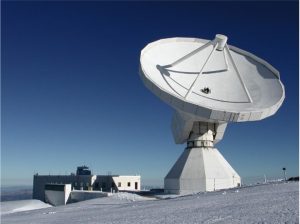
Télescope de 30-mètres de l'IRAM à Pico Veleta, à 2850 mètres (Sierra Nevada espagnole).
This is a camera based on KID arrays for observations in the millimeter waveband with the IRAM 30-meter telescope. The camera was designed and built by the NIKA2 collaboration with funding from the ANR. The LPSC was heavily involved in the construction of NIKA2 and was responsible for the electronics and commissioning. NIKA2 operates in two frequency bands (1.2 and 2 millimeters) and contains thousands of KIDs. It is a unique instrument for continuum observations in the millimeter waveband. The NIKA2 collaboration has secured 1,300 hours of guaranteed observing time from IRAM, distributed across five major programs. The LPSC is leading the LPSZ, a major Sunyaev-Zel’dovich (SZ) observation program dedicated to cosmology using galaxy clusters. This program consists of resolved SZ observations of 35 clusters at redshifts between 0.5 and 0.9 from the Planck and ACT catalogs. It is a cornerstone for measuring the scaling relation between the mass of clusters and their SZ observable, as well as the universal pressure profile of clusters, both of which are crucial for cosmology involving galaxy clusters. We have also led the development of the polarization measurement system, which we are using to calibrate the polarization of future CMB experiments aimed at measuring the primordial B-modes associated with inflation.
(retourner à la liste des projets)
RadioForegroundsPlus (ERC)
This is the HORIZON-CL4-2023-SPACE-01 project, in which the team serves as co-PI, aimed at precisely characterizing polarization emissions from dust and the galactic synchrotron in order to reduce their contamination in measurements of CMB polarization anisotropies, particularly primordial B-modes. This project follows on from the ERC H2020 COMPET-5 RADIOFOREGROUNDS project, in which the team also served as co-PI. That project resulted in the release of a public code for modeling the galactic magnetic field and polarization foreground emissions.
(retourner à la liste des projets)
Cosmic Radiation and Indirect Detection of Dark Matter
Measurements of cosmic rays with AMS-02 and gamma rays with Fermi-LAT (and CTA), beyond their many astrophysical implications, allow us to investigate various dark matter candidates. These two research areas (and the major questions associated with them) can only advance through an approach that is both multi-wavelength (radio, X-rays, γ) and multi-messenger (photons, neutrinos, leptons, and nuclei, and even gravitational waves). Although this activity has become a minority focus within the team, several tools widely used by the community continue to be maintained (the CRDB cosmic-ray database, the CLUMPY code for calculating gamma-ray dark matter signals, and the USINE propagation code).
(retourner à la liste des projets)
SO
The Simons Observatory (SO) experiment, which aims to measure temperature and polarization anisotropies in the CMB with unparalleled precision, is currently being installed in the Atacama Desert in Chile. With six SAT (“small aperture telescope”) instruments and one LAT (“large aperture telescope”), SO will enable both the study of primordial B-modes in the CMB’s polarization and the mapping of matter in the Universe using gravitational lensing and the SZ effect. This is both a project with tremendous scientific potential in our group’s field of interest and a premier “pathfinder” for next-generation instruments such as CMB-S4. As part of the CNRS AAR call for proposals, we propose the construction and outfitting of a SAT with a new instrument based on KID technology developed by GIS-KID in Grenoble. In terms of polarization measurement, we plan to use technology similar to that of NIKA and NIKA2. By aiming for an instrument capable of observing at high frequencies (above 200 GHz) and thanks to KID technology, we could make a significant contribution to SO through: (i) better coverage of the focal plane; (ii) redundancy for subtracting atmospheric contamination; and (iii) a larger frequency leverage to reduce the contribution of galactic dust to the primordial B-modes of the CMB. Assuming funding in 2024, It is realistic to consider installing it during the second phase of operations (“Advanced SO”). We also wish to focus on cosmological analyses related to gravitational lensing and galaxy clusters. These analyses are closely linked to our current work at the LPSZ (with NIKA2) and will serve as a springboard for our participation in CMB-S4 and LiteBIRD.(retourner à la liste des projets)
Team Members
[contact : prenom.nom at lpsc.in2p3.fr]
Permanent Employees
- Johan BREGEON (CR) – Sursauts gamma orphelins avec LSST, broker d'alerte FINK
- Andrea CATALANO (DR) – Instrumentation KIDs, CMB sol et espace
- Céline COMBET (DR) – Cosmologie avec les amas, LSST, Euclid, détection indirecte matière noire
- Johan COMPARAT (CPJ UGA) – Grands relevés, eROSITA, LSST, Euclid
- Cyrille DOUX (CR) – Lentillage gravitationnel, simus, statistiques non-gaussiennes, machine learning
- Marine KUNA (Maîtresse de conférence UGA) – Courants stellaires et blending avec LSST
- Juan MACÍAS-PÉREZ (DR) – Euclid, NIKA2, instrumentation, CMB, RadioForegrounds+
- David MAURIN (DR, resp. équipe) – Rayonnement cosmique, détection indirecte matière noire
- Frédéric MAYET (Professeur UGA) – SZ avec NIKA2, CMB sol et espace
- Anna NIEMIEC (Maîtresse de conférence UGA) – Amas de galaxies, simulations, cosmologie, LSST
- Laurence PEROTTO (DR) – CMB sol et espace, SZ NIKA2, CMB lensing, Euclid, corrélations croisées
- Alessia RITACCO (CPJ CNRS) – Instrumentation KIDs et polarisation, CMB sol et espace
Associate Researcher
- Nicolas Ponthieu (IPAG, depuis 2011) – CMB sol et espace et polarisation
Postdoctoral researchers
- Anthony CORREIA (2026-2027) – Section efficaces/rayons cosmique avec IA/ML
- Silvia MICHELI (2026-2027) – COSMOCal
- Mathias REGNIER (2026-2028) – COSMOCal
- Alessandro VADALA (2027-2029) – LSST/Roman (statistiques non-gaussiennes)
- Shiyang ZHANG (2026-2028) – LSST/Roman (lensing with IA/ML)
Ph.D. students
- Victor CHALAMET (2025-2028) – IRAM et mm
- Lili DIGOUT (2026-2029) – Euclid (lensing amas de galaxies)
- Benedetta KALEMI (2025-2028) – Instrumentation KIDs et télescopes CMB
- Samuel MESQUITA (2025-2028) – LSST (« blending »)
- Louis MIROUZE (2024-2027) – Euclid (amas de galaxies)
- Matthieu PÉLISSIER (2024-2027) – LSST (courants stellaires et matière noire)
- Hugo Sedlacek (2026-2029) – Euclid/LSST (cosmologie multi-λ)
Long-term visits
- Aashay PAI (PhD USA 2026-2027) – LSST
Former Postdocs/Visiting Scholars (since 2020)
- Caio LIMA DE OLIVEIRA (PhD Brésil 2025-2026) – LSST
- Pratiksha SAWANT (PhD Italie 2025-2026) – Rayonnement cosmique
- Aparajita SEN (post-doc 2024-2026) – RadioForegrounds+
- Mateo FERNÁNDEZ-TORREIRO (post-doc 2023-2025) – NIKA2
- Juan MENA-FERNÁNDEZ (post-doc 2023-2025) – LSST
- Eduardo BARROSO (PhD Brésil 2022-2023) – LSST
- Emmanuel ARTIS (post-doc 2020-2022) – NIKA2
- Calum MURRAY (post-doc 2020-2022) - LSST
Theses in Progress
- Victor CHALAMET (2025-2028) – IRAM et mm
- Lili DIGOUT (2026-2029) – Euclid (lensing amas de galaxies)
- Benedetta KALEMI (2025-2028) – Instrumentation KIDs et télescopes CMB
- Samuel MESQUITA (2025-2028) – LSST (« blending »)
- Louis MIROUZE (2024-2027) – Euclid (amas de galaxies)
- Matthieu PÉLISSIER (2024-2027) – LSST (courants stellaires et matière noire)
- Hugo SEDLACEK (2026-2029) – Euclid/LSST (cosmologie multi-λ)
Theses Defended (since 2020)
- Challenges en astrophysique et en cosmologie avec des caméras KIDs
Damien CHEROUVRIER (dir. J. F. Macías-Pérez), 2025
Devenir : post-doc University of Cincinnati - Identification des sursauts gammas orphelins avec Vera C. Rubin et le broker d'alerte FINK
Marina MASSON (dir. J. Bregeon), 2025
Devenir : recherche de post-doc/job - Cosmologie à partir des observations SZ d'amas de galaxies avec NIKA2 au télescope de 30m
Alice MOYER-ANIN (dir. F. Mayet), 2025
Devenir :post-doc Tokyo University / KAVLI Institute - Analyse cosmologique des données de lentillage gravitationnel faible dans Rubin-LSST
Manon RAMEL (dir. C. Doux et M. Kuna), 2025
Devenir : post-doc University of Cincinnati - La technologie de KIDs pour la prochaine génération de télescopes CMB
Sofia SAVORGNANO (dir. A. Catalano & A. Monfardini), 2025
Devenir : post-doc Boston University - Cosmologie avec les amas de galaxies du grand programme Sunyaev-Zeldovich de NIKA2
Corentin HANSER (dir. L Perotto), 2024
Devenir : post-doc CPPM Marseille - Cosmologie multi-longueur d'onde avec les amas de galaxies
Miren MUÑOS ECHEVARRÍA (dir. J. F. Macías-Pérez), 2023
Devenir : post-doc IRAP Toulouse - Cosmologie avec les amas de galaxies à l'ère du LSST
Constantin PAYERNE (dir. C. Combet), 2023
Devenir : post-doc IRFU/DPHP Saclay - Cosmologie à partir des observations Sunyaev-Zeldovich d’amas de galaxies avec NIKA2
Florian KÉRUZORÉ (dir. F. Mayet), 2021
Devenir : post-doc Argonne National Lab. (IL, USA) - Préparation à l’analyse et interprétation des amas de galaxies avec Euclid
Alejandro JIMÉNEZ MUÑOZ (dir. J. F. Macías-Pérez), 2021
Devenir : post-doc Université de Madrid - Un spectro-imageur dédié aux observations des anisotropies secondaires du fond diffus cosmologique
Allessandro FASANO (dir. A. Monfardini & A. Catalano), 2020
Devenir : postdoc Instituto de Astrofísica de Canarias (IAC)